

















Shipping toUnited States
ENUSD
0

Author: user

  • Commercial Lawn Mower & Turf Equipment Lifts: Safe Under-Deck Maintenance & Storage Guide

    Maintaining commercial zero-turn mowers, turf maintenance tractors, and heavy utility vehicles (UTVs) requires reliable, unobstructed access to under-deck cutting assemblies, spindle pulleys, drive belts, and hydraulic wheel motors. Using improper floor jacks or unstable wooden blocks creates severe workshop hazards. Investing in a dedicated commercial lawnmower storage lift or 2-post turf adapter kit provides maximum safety, ergonomics, and workshop efficiency.

    Single-Column Mower & UTV Lifts

    Single-column storage and service lifts, such as the Tuxedo SC-2K and iDEAL SC-2K-UTV-X, provide up to 2,000 lbs of lifting capacity with a compact single-post footprint. These specialized lifts feature adjustable wheel cradles engineered specifically for riding lawnmowers, commercial zero-turn mowers, golf carts, and side-by-side UTVs.

    • Under-Deck Blade Access: Raises mowers up to 81 inches, allowing technicians to inspect, sharpen, and replace commercial mower blades while standing upright.
    • Winter Off-Season Storage: Safely stores turf equipment in the elevated position, freeing up valuable floor space in landscape fleet shops.
    • 110V Standard Power: Operates on standard 110V residential or commercial 15A/20A power circuits.

    2-Post Lift Turf & Lawnmower Adapter Kits

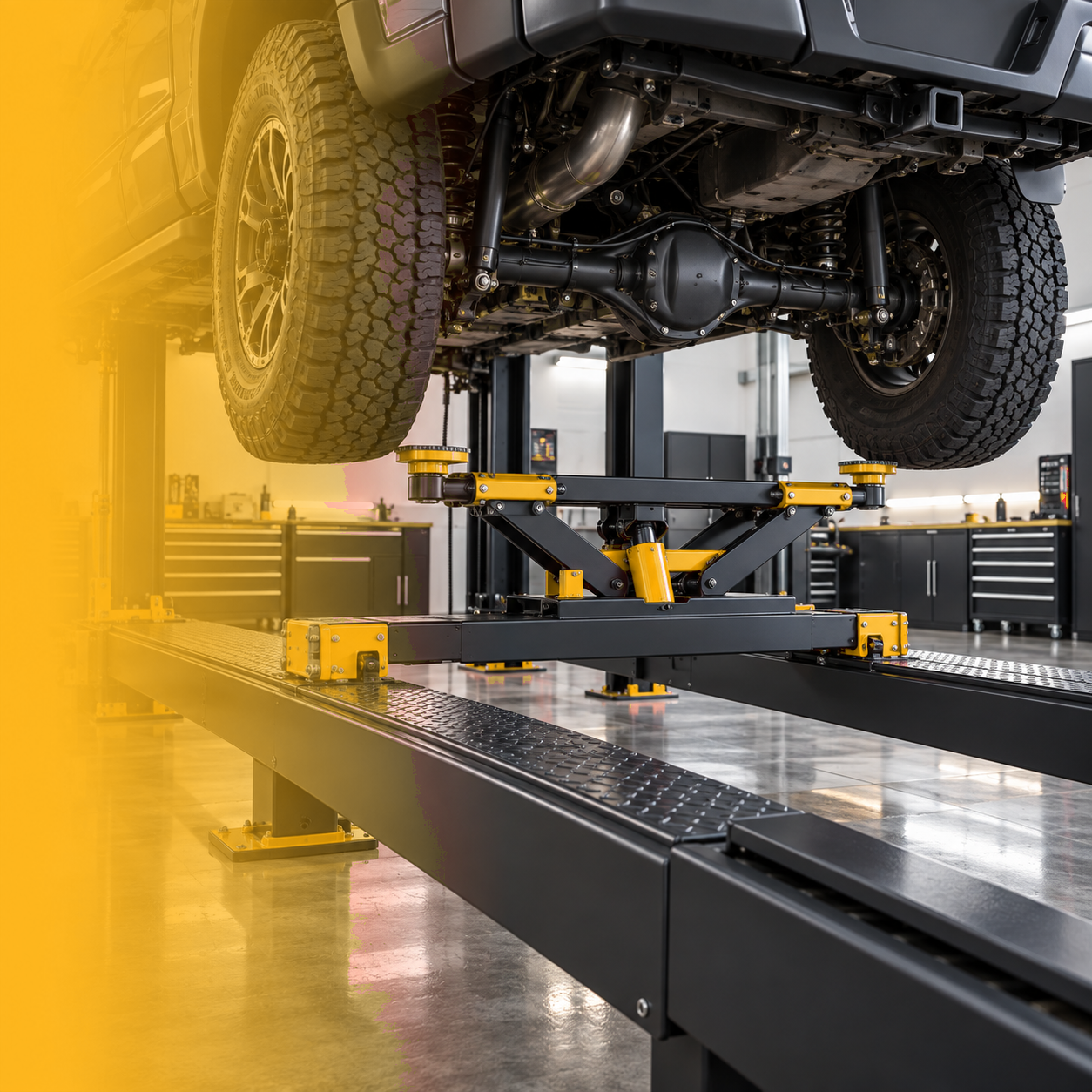
    For automotive workshops and municipal fleet garages that already utilize standard 2-post car lifts (such as BendPak 9K/10K or Atlas 9KOHX/BP8000), turf lift adapter combos convert a standard 2-post automotive lift into a full-service turf equipment maintenance bay.

    • Dual Utility: Switch between lifting passenger trucks and zero-turn lawnmowers in under five minutes.
    • Heavy Duty Capacity: Supports heavy turf equipment, wide-area rotary mowers, and diesel compact tractors up to 9,000 lbs.

    Explore our complete selection of commercial automotive lifts, lawnmower service lifts, and turf kits with free shipping across the United States at Greg Smith Equipment Sales.

  • Car Lift Ceiling Height & Installation Requirements for Home & Pro Garages

    Before ordering an automotive vehicle lift, measuring your garage dimensions accurately and evaluating structural concrete specifications are essential steps to ensure safe, trouble-free installation and operation.

    How to Calculate Required Ceiling Height

    The minimum ceiling height required for a car lift depends on whether you plan to perform stand-up undercarriage service or stack two vehicles for storage:

    Formula for Vehicle Storage (4-Post Lifts):

    Minimum Ceiling Height = Height of Vehicle 1 (on runways) + Height of Vehicle 2 (underneath) + Runway Thickness (approx. 4.5 inches) + Safety Lock Clearance (approx. 4 inches)

    Example: Storing a 55-inch sports car over a 70-inch SUV requires: 55″ + 70″ + 4.5″ + 4″ = 133.5 inches (11 feet 2 inches) of clear ceiling height.

    Formula for Stand-Up Maintenance (2-Post Lifts):

    Full-rise commercial 2-post lifts raise vehicles between 69 and 75 inches. With a 70-inch truck raised 72 inches, total height reaches 142 inches (11 feet 10 inches). Clear-floor 2-post lifts typically feature overhead crossbeam heights of 142″ to 192″, requiring 12 to 16 feet of unobstructed ceiling clearance.

    Low-Ceiling Garage Alternatives

    If your garage has standard 8-foot to 10-foot ceilings, you still have excellent lifting options:

    • Portable Low-Rise & Mid-Rise Lifts: QuickJack portable frames and mid-rise scissor lifts raise vehicles 24 to 36 inches, providing ample clearance for brake jobs, tire rotations, exhaust work, and detailing in 8-foot ceiling spaces.
    • Floor-Plate 2-Post Lifts: Models with total column heights under 111 inches (9 feet 3 inches) fit comfortably beneath 10-foot residential ceilings.

    Concrete Slab Thickness and Quality

    • 2-Post Lifts: Require a minimum 4-inch thick concrete slab (3,000 PSI rating minimum). Anchor bolts must be embedded at least 3.25 to 4 inches away from slab edges, joints, and cracks.
    • 4-Post Lifts: Distribute vehicle load across 4 large base plates, requiring standard 4-inch 3,000 PSI concrete.

    Explore all automotive vehicle lifts with detailed model dimensions and specifications at Greg Smith Equipment Sales.

  • Mini Excavator Buying Guide: Operating Weight, Digging Depth & Engine Specs

    Compact and mini excavators have become essential machinery for landscape contractors, utility installers, agricultural operations, and property developers. Ranging from 1-ton ultra-compact micro diggers to 2.5-ton utility excavators, these hydraulic machines deliver formidable digging power in tight spaces where full-size earthmovers cannot operate.

    Understanding Mini Excavator Weight Classes

    Operating weight directly dictates digging force, lifting stability, trailer transport requirements, and ground disturbance:

    • 1.0 to 1.2 Ton Class (Micro Excavators): Features retractable tracks (typically 31 to 38 inches wide) allowing the machine to pass through standard backyard garden gates and interior doorways. Digging depth ranges from 5.5 to 6.5 feet. Can be transported easily on standard utility trailers behind half-ton pickup trucks.
    • 1.5 to 1.8 Ton Class (Utility Excavators): Offers expanded hydraulic flow for hydraulic breakers and augers, longer boom reach (6.5 to 7.5 ft dig depth), and enhanced operator comfort with enclosed cab options.
    • 2.0 to 2.5 Ton Class (Compact Commercial Excavators): Heavy-duty residential and commercial excavation, foundation trenching, and utility line installation with digging depths up to 8.5 feet and greater breakout forces.

    Engine Selection: Diesel vs. EPA Gasoline

    Modern mini excavators available at Greg Smith Equipment Sales are powered by two industry-proven engine platforms:

    • Kubota Diesel Engines (e.g., Kubota D902 / D722): Renowned for exceptional torque at low RPMs, fuel efficiency, extreme longevity, and worldwide parts availability. Ideal for commercial contractors operating daily multi-hour shifts.
    • Briggs & Stratton EPA Gas Engines (e.g., 13.5 HP 420cc): Delivers reliable starting, EPA-certified emissions compliance, lower initial acquisition cost, and simplified maintenance without complex diesel particulate systems. Ideal for farms, estate maintenance, and rental operations.

    Essential Features to Consider

    • Boom Swing Capability: Allows the boom to pivot independently of the chassis, enabling offset trenching parallel to building foundations, fences, and property lines.
    • Pilot Joystick Controls: Hydraulic pilot controls provide smoother, more precise multi-function operation compared to mechanical manual levers.
    • Hydraulic Thumb Clamp: Essential for grabbing rocks, logs, brush, demolition debris, and landscaping boulders.
    • Auxiliary Hydraulic Piping: Powers attachments including hydraulic augers, post hole diggers, rock breakers, and grapples.

    Browse our complete selection of commercial compact and mini excavators with nationwide delivery support at Greg Smith Equipment Sales.

  • 2-Post vs. 4-Post Car Lifts: The Complete Commercial & Home Garage Buying Guide

    Selecting the right automotive lift is one of the most critical investments for commercial repair facilities, automotive restoration specialists, and home garage enthusiasts. When evaluating commercial vehicle lifts, the primary decision centers between 2-post car lifts and 4-post vehicle lifts. Each design offers distinct operational advantages depending on your ceiling height, concrete slab thickness, intended service work, and vehicle storage requirements.

    Key Differences at a Glance

    While both 2-post and 4-post lifts raise vehicles safely for undercarriage access, their structural design, footprint, and vehicle support mechanisms differ significantly:

    • 2-Post Car Lifts: Frame-engaging lifts where the vehicle rests on four adjustable swing arms. Provides complete “wheels-free” suspension and brake access with the smallest floor footprint.
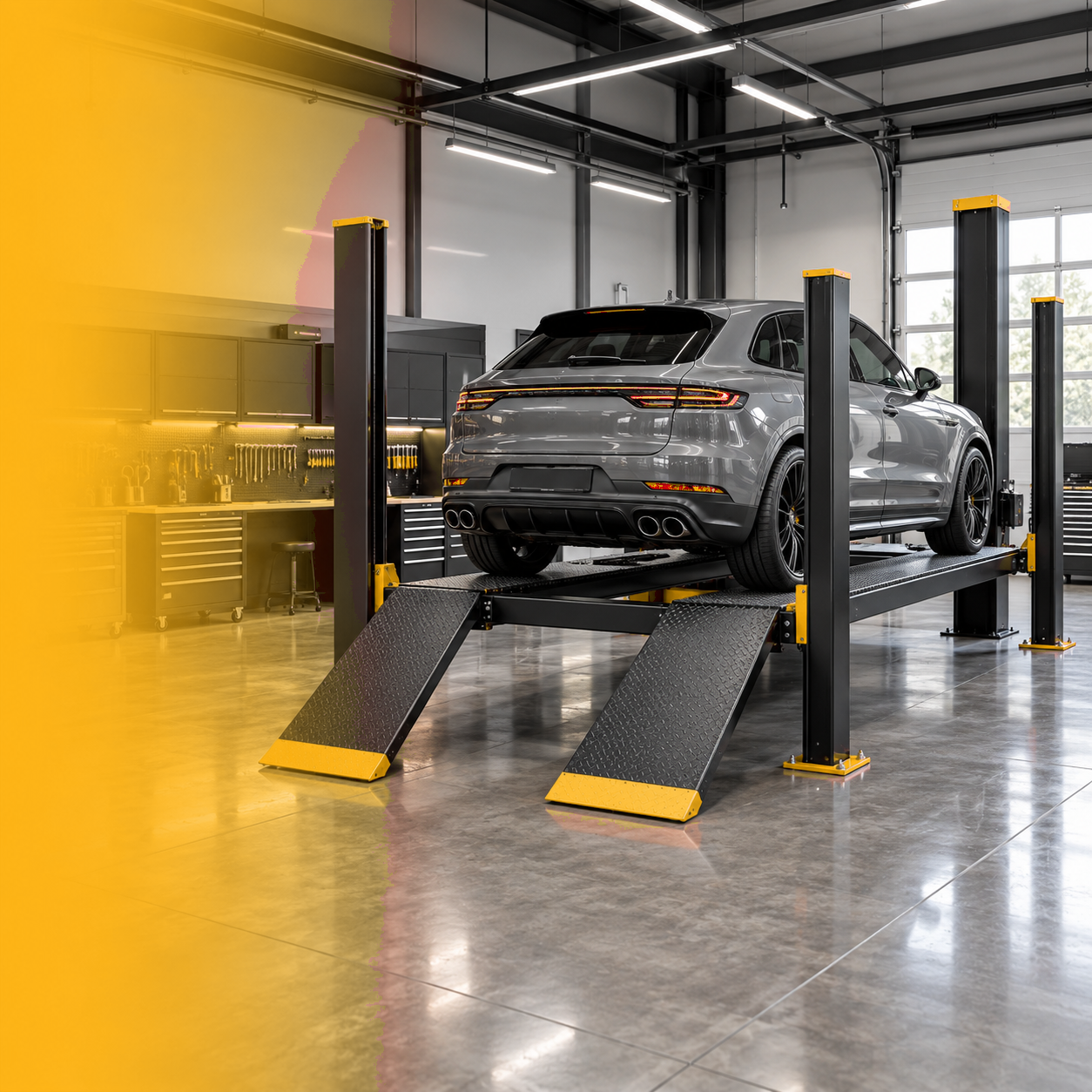
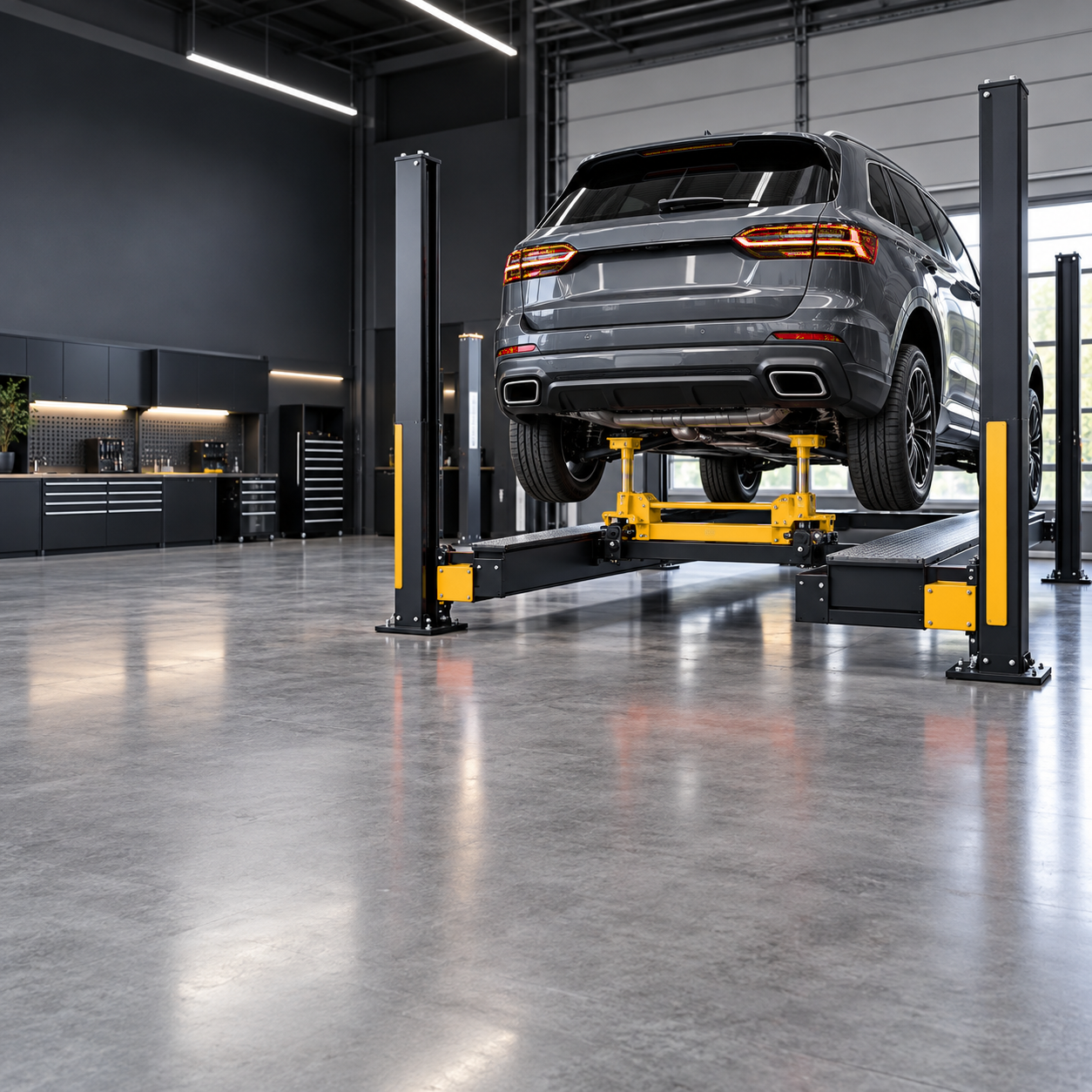
    • 4-Post Car Lifts: Drive-on runway lifts where the vehicle rests on heavy-gauge steel ramps. Ideal for vehicle storage/parking multiplication, routine fluid changes, wheel alignments, and heavy fleet service.

    When to Choose a 2-Post Car Lift

    A 2-post car lift is the industry standard for professional mechanical repair. Because the lift engages the vehicle frame rather than the tires, the wheels hang free immediately upon raising. This configuration provides unobstructed access for:

    • Complete brake service, rotor replacement, and caliper maintenance
    • Wheel, tire, and suspension component overhauls
    • Transmission removals, clutch replacements, and drivetrain repairs
    • Exhaust system fabrication and underbody chassis work

    Clear-Floor vs. Floor-Plate 2-Post Lifts

    2-post lifts are available in two primary configurations: Clear-Floor (Overhead Beam) and Floor-Plate (Base Plate). Clear-floor models run hydraulic lines and equalization cables through an overhead crossbar, leaving the floor completely flat for rolling oil drains and transmission jacks. Floor-plate models house hydraulic lines beneath a low-profile floor threshold, making them ideal for garages with ceiling heights under 12 feet.

    When to Choose a 4-Post Car Lift

    A 4-post vehicle lift is the ultimate choice for vehicle storage, quick maintenance, and heavy commercial applications. Driving directly onto the runways eliminates the need to bend down and position swing arms under designated chassis lift points.

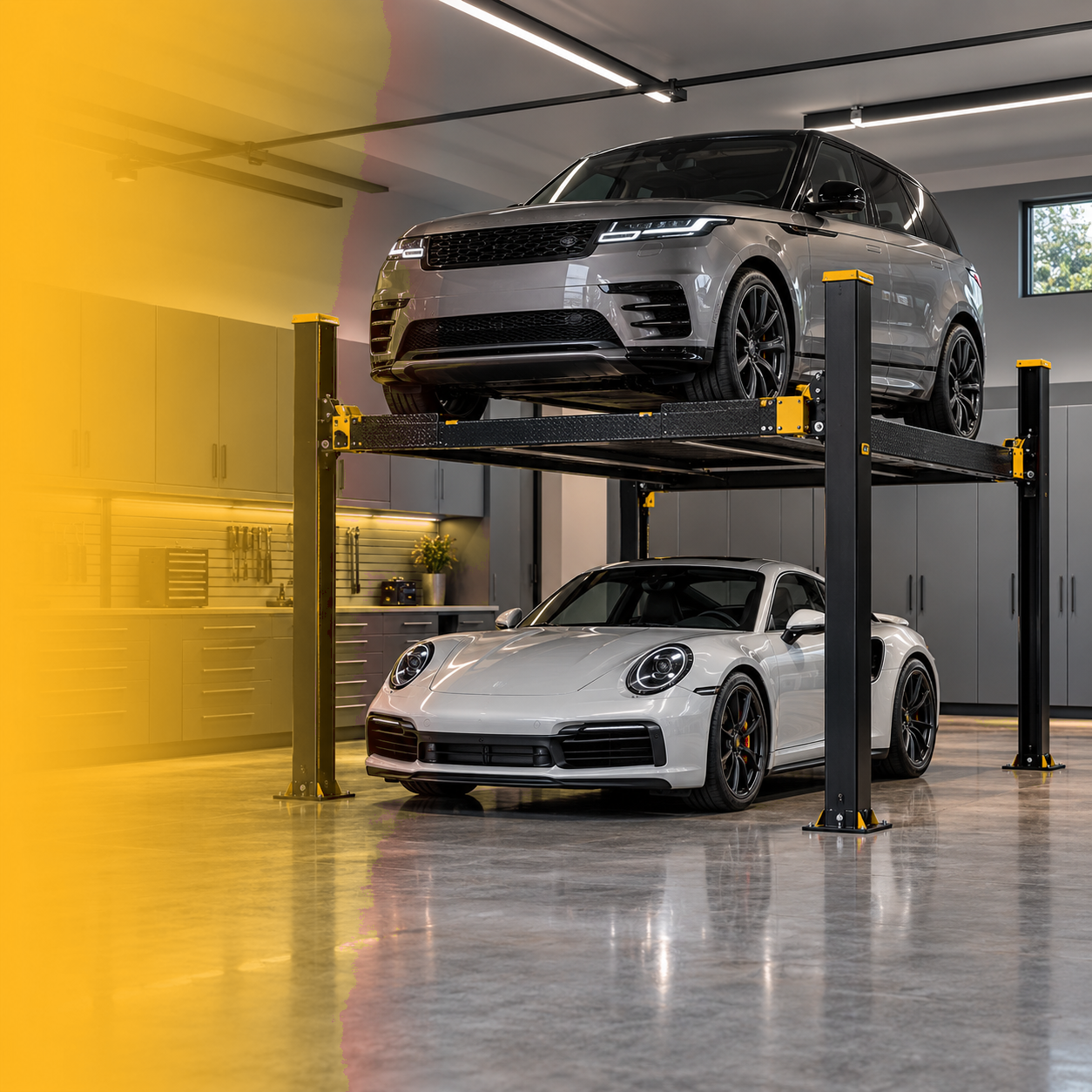
    • Double Your Parking Space: A 4-post lift allows you to park one vehicle on the runways in the raised position and park a second vehicle underneath, effectively doubling single-stall storage capacity.
    • No Permanent Floor Anchoring Required for Storage: Many residential 4-post lifts can be operated free-standing with an optional caster kit for mobility.
    • High Capacity Fleet Capability: Available in capacities ranging from 7,000 lbs up to 40,000 lbs for commercial trucks, RVs, and municipal fleet vehicles.
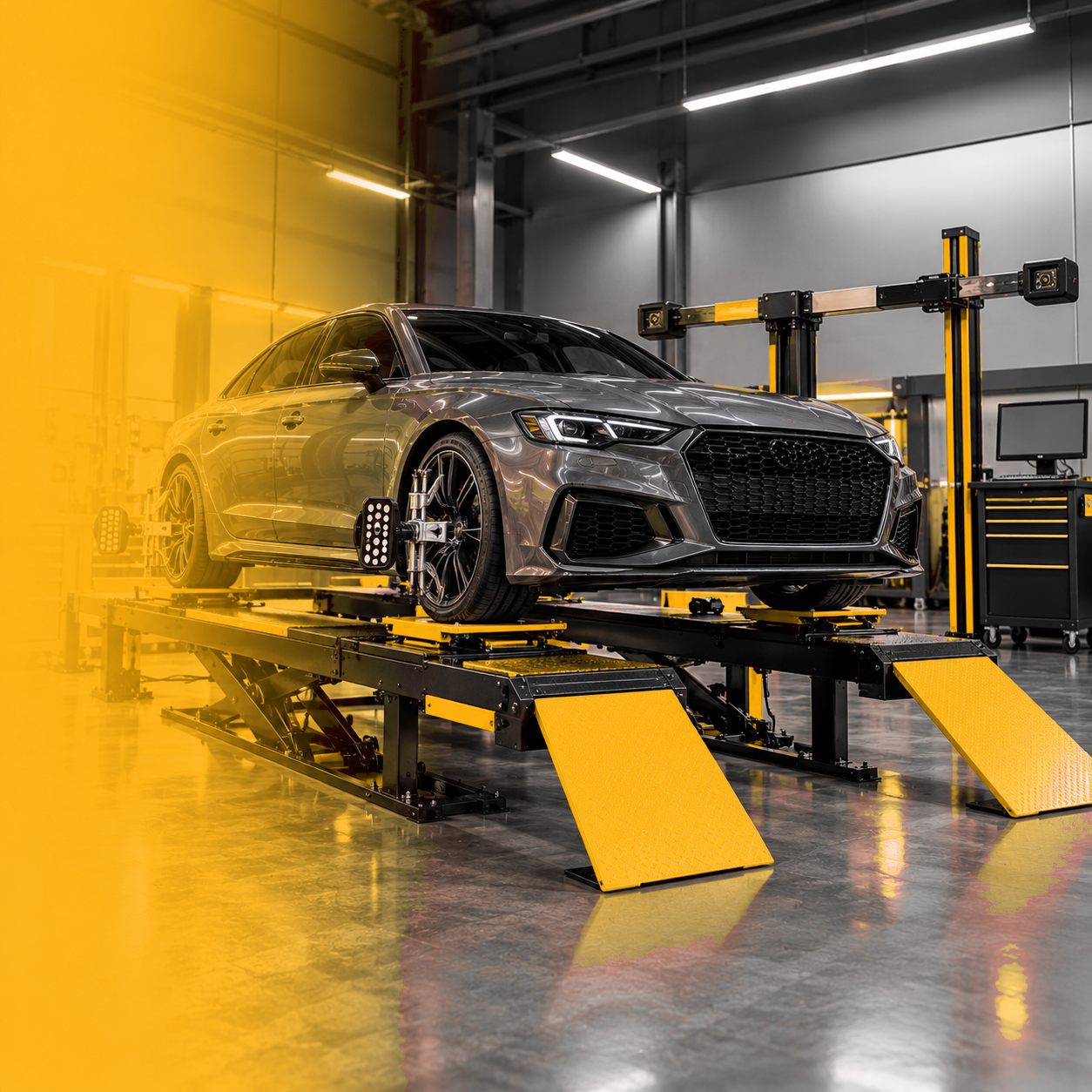
    • Wheel Alignment Capability: Specialized alignment 4-post lifts incorporate slip plates and turnplate pockets for precision alignment calibration.

    Concrete & Installation Requirements

    Before installing any automotive lift, verify that your garage floor meets manufacturer specifications:

    • 2-Post Lifts: Require a minimum 4-inch (preferably 6-inch for 12K+ lb models) reinforced concrete slab rated at 3,000 PSI minimum. Concrete must be fully cured (at least 28 days) and free of cracks near anchor locations.
    • 4-Post Lifts: Distribute weight across four contact points, typically requiring a standard 4-inch 3,000 PSI slab.
    • Electrical Requirements: Most commercial 2-post and 4-post power units operate on 208–230V single-phase 30-amp dedicated circuits, while smaller portable units may utilize 110V 20A power.

    Explore our complete inventory of automotive vehicle lifts with free standard freight shipping across the United States at Greg Smith Equipment Sales.

  • Hello world!

    Welcome to WordPress. This is your first post. Edit or delete it, then start writing!